Um blog de inglês para estrangeiros, principalmente para falantes de língua portuguesa. Aprimore seus conhecimentos de vocabulário (collocations, slangs, idiomatic expressions), pronúncia, gramática. O blog também é voltado para aqueles que procuram ideias para o ensino de inglês como língua estrangeira.
Total Pageviews
Showing posts with label What's the Difference?. Show all posts
Thursday, 29 November 2018
Friday, 7 July 2017
LIKE/ AS/ ALIKE: DO YOU KNOW THE DIFFERENCE?
In English, like means 'similar to' and is used when comparing things. In Portuguese, both like and as mean ‘como’. Look at these examples:
'He’s 40 years old, but sometimes behaves like a child'.
It means that he is not a child, but sometimes behaves similar to a child.
'Her hands were so cold. There were like ice cubes'. I’m comparing the temperature of her hands to ice cubes.
As means ‘in the condition of’.
I say “I work as a teacher”. Like can not be used here, because I don’t work similar to a teacher. I really am a teacher.
Sometimes, like and as have no difference in meaning, that is, both mean “in the same manner/ way that ”. In fact, they only differ in grammar:
a) Like is followed by a noun/ pronoun
e.g Do exactly like me.
b) As is followed by a clause (subject +verb)
e.g
Do exactly as I say.
She passed the exam, as I expected she would.
Note that In American English, and sometimes in informal British English, like can also be used before a clause.
e.g
Nobody teaches those children as I do/ like I do.
Alike in English means ‘similar to each other’ ( in Portuguese= igual, parecido, semelhante). It is used after a linking verb such as be, seem, look, predicatively:
e.g
Nowadays, we can say that all politicians are alike in Brazil.
Alike also means ‘in the same manner' ( In Portuguese= igualmente) and is used as an adverb.
e.g
They treat their children alike.
Monday, 19 June 2017
FIRST VS FIRSTLY VS AT FIRST
Since first, firstly and at first have similar spellings, you might well think that they are synonyms, but they are not. Using these words is not difficult, but misusing them can make a huge difference in meaning. Therefore, learning these words in context is the most practical way to build vocabulary and to understand their use.
First means ‘preceding all others’.
e.g
'First, second and third are ordinal numbers in English'.
I’m always the first to arrive.”
'Who was the first person to travel into outer space?
In the sentence "When I first saw you, I said “Oh, my”!, first is the same as ‘for the first time’ ( In Portuguese= pela primeira vez)
When we MAKE LISTS, we can use both first or firstly. In Portuguese both words mean “primeiramente”. Some lexicographers say that they differ in degree of formality. Firstly is more formal than first. e.g "There are several reasons for studying English. First (ly,)…”. Anyway, no matter which one you choose, it is important to know that they are not always interchangeable. Note that we say first and foremost, not 'firstly and foremost’ and first of all, not 'firstly of all’.
At first means ‘initially’( In Port. = no início). E.g "At first, I didn’t like her very much, but now we are good friends.”
Is the difference in meaning clear now?
Thursday, 1 June 2017
EVERY DAY or EVERYDAY ?
Just a quick post to tell you the difference between EVERY DAY and EVERYDAY.
The adverbial expression 'EVERY DAY' (written separately) expresses how often you do something. In Portuguese it means “todos os dias”. The phrases 'every day’, 'every week’, ‘every month’ and ‘every year’ are usually at the end or at the beginning of the sentence.
E.g.
Every day he goes to the gym
He goes to the gym every day.
EVERYDAY is just one word and it is an adjective. So, it is used next to a noun (=substantivo) to qualify it. In Portuguese, ‘everyday' means 'típico', 'ordinário', ‘rotineiro'. Let’s have a look at some examples:
English is part of my everyday life.
There are everyday problems waiting to be solved.
Note that some words are commonly used with EVERYDAY
E.g.
- Everyday story
- Everyday use
- Everyday life
- Everyday problems
- Everyday family
Is the difference between EVERY DAY and EVERYDAY clear now? I hope so.
Cheers!
Tuesday, 11 April 2017
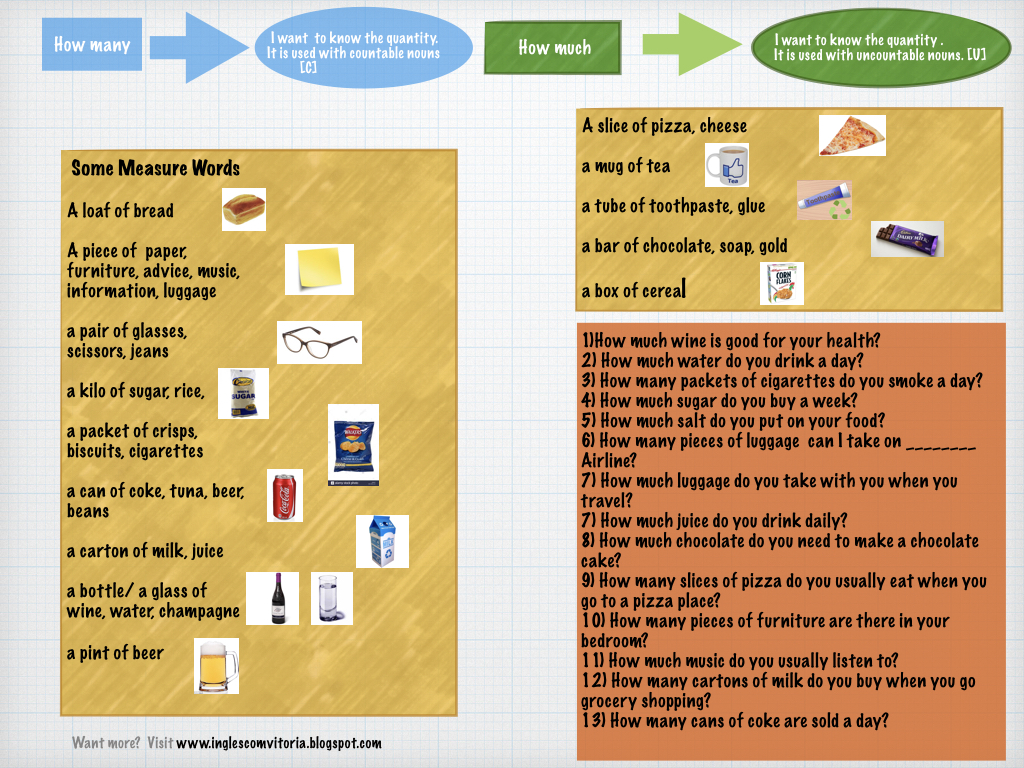
'HOW MANY'/ 'HOW MUCH' / MEASURE WORDS
Is it difficult to use ‘How many’ and 'How much’? If your answer is 'yes', let’s learn to use these quantifiers correctly.
The rule is: we make the difference between ‘how many’ and ‘how much’ by saying that ‘how many' is used with countable nouns [C] and 'how much’ with uncountable nouns [U]. An uncountable noun is not used with "a" or "an" and cannot be made plural. By contrast, a countable noun is used with the indefinite articles (a/an) and can be used in the plural.
Ok, fair enough. But, is it possible to measure uncountable nouns? If so, how? Actually, we can make an uncountable word countable by using measure words (eg. a kilo), or by putting the uncountable noun in a container (e.g, a packet, a bottle).Take for example the following sentences:
How much sugar do you take in your coffee?
How many spoons of sugar do you put in your coffee?
Do you realize that both sentences are correct in English? 'How much' is used in the first sentence because ‘sugar' cannot be counted. However, once we put the word in a container (e.g a spoon), it takes the plural form and it becomes possible to use “How many”.
The diagram above shows the most common measure words in English. Have a look at them and try to answer the questions.
For Portuguese Speakers Only!
Em Português, “How many” e ‘How much” são expressões interrogativas que significam “Quantos/ quantas” e “Quanto”, respectivamente. A tradução já indica que “How many” é usado com substantivos contáveis (veja que o pronome interrogativo está no plural ‘quantos/as' para concordar com o substantivo). Já ‘how much' é usado com substantivos incontáveis. Para quantificar substantivos incontáveis, nós usamos medidas (quilo, colher, etc). Nesse caso, torna-se possível o uso de ‘how many’.
Friday, 31 March 2017
Friday, 17 February 2017
Tuesday, 14 February 2017
Thursday, 2 February 2017
Sunday, 29 January 2017
Monday, 9 January 2017
Tuesday, 3 January 2017
Thursday, 29 December 2016
Tuesday, 27 December 2016
Thursday, 22 December 2016
SO VS SUCH
You are so beautiful
Lesson Plan
- Divide the class into groups( Alternatively, work individually)
- Each group is assigned one stanza of the song.
- The students are supposed to listen to the song, write what they hear and create their version of the song;
- After the listening activity, a member of each group writes it on the board;
- The whole class listens to the song again in order to correct the first version provided.
- If necessary, provide the students with a correct lyrics sheet.
- Easily confused words - Difference between so and such
Lyrics
You are so beautiful to me
Can't you see?
You're everything I've hoped for
And you are everything I need
You are so beautiful to me
Can't you see?
You're everything I've hoped for
And you're everything I need
You are so beautiful
To me
Subscribe to:
Posts (Atom)