This is a worksheet I like using on the 1st day of class to practise student-teacher classroom language. Students are expected to fill in the gaps according to the pictures provided. This set of classroom vocabulary is very helpful for elementary/ pre-intermediate students to interact with the teacher in English. Hope you like it.
Um blog de inglês para estrangeiros, principalmente para falantes de língua portuguesa. Aprimore seus conhecimentos de vocabulário (collocations, slangs, idiomatic expressions), pronúncia, gramática. O blog também é voltado para aqueles que procuram ideias para o ensino de inglês como língua estrangeira.
Total Pageviews
Showing posts with label Elementary English ( A1). Show all posts
Thursday, 22 February 2018
Wednesday, 16 August 2017
50 PAST SIMPLE CONVERSATION QUESTIONS FOR BEGINNERS
CHILDHOOD AND RECENT PAST
- Where were you born?
- When were you born?
- Where did you grow up?
- Who was your childhood best friend?
- Were you a naughty or a quiet child?
- What kind of food did you eat when you were a child?
- What games did you like playing when you were a child?
- What TV shows did you enjoy?
- Where did you live as a child?
- What was your city like when you were a child/… years ago?
- Did you live in a house or in a flat?
- Was it big or small?
- Did you have your own bedroom?
- How many rooms were there?
- Did you have a happy childhood?
- Was _____________ your first school?
- How old were you when you started to study?
- Did you like your first school?
- Who was your first teacher? Was he/she nice?
- What school subjects were you good at?
- How long did you study there?
- How old were you when you started to study English?
- What did you do for you last holiday?
- What time did you get up this morning?
- What did you do after you got up?
- What did you eat for breakfast this morning?
- What time did you have breakfast this morning?
- Did you go to school this morning?
- What time did you go to school?
- Who did you go to school with?
- Who did you meet at school this morning?
- What did you have for lunch?
- What did you do yesterday?
- When was the last time you went to the cinema? What did you see?
- Where did you go last weekend?
- Who did you go with?
- When did you start to ( e.g play …/dance classical ballet?)
- When was the last time you went shopping?
- What did you buy?
- How much did you spend?
- When was the last time you went to a good restaurant?
- What did you eat?
- When did you last go to a party?
- Did you have fun?
- What was the weather like yesterday?
- What time did you arrive home yesterday?
- What time did you go to bed last night?
- Did you sleep well last night?
- Did you have a shower before going to bed?
- What did you do before you went to bed?
Wednesday, 3 May 2017
GREETINGS AND INTRODUCTIONS
You may already know “hello” and “how are you?” in English. However, English speakers don’t always use these greetings?”There are many other expressions to use and sound more natural. So, how about learning some of them?
Have a look at the digram above and start putting the phrases into practice.
There are a few expressions I would like to add:
a)”Long time no see”
b) "It’s been a while.”
c) It’s been ages.
These casual greetings are used when you haven’t seen someone for a long time, mainly if you meet that person by chance. These phrases are usually followed with a question like “how are you”, “how have you been?” or “what’s new?”
It’s important to note that "How do you do?” is a formal greeting. The proper response is “how do you do?”. Besides that, "Good morning", "Good afternoon", or "Good evening are formal ways of saying “hello”. Bear in mind that “good night” is only used to say “good bye”, so if you meet someone late in the day, remember to greet him/her with “good evening”, rather than “good night”. Good morning can be made more casual by simply saying “morning”.
Some equivalent expressions in Portuguese.
Hello/ Hi = Oi/ Olá!
Hey! = Ei!
How are you? = Como você está?
How’s it going/ How’s everything? = Como vão as coisas?
It’s a pleasure to meet you. = É um prazer conhecê-lo.
It’s been such a long time/ It’s been ages (since I met you)./ It’s been a long time= Há quanto tempo…
I’m doing well or I’m doing fine. = Eu estou indo bem.
What’s up = E aí?
What’s new? = O que há de novo?
What’s going on? = o que está rolando?
How have you been?= Como tem passado?
Hello, stranger! = E aí, sumido!
Thursday, 27 April 2017
PRESENT CONTINUOUS (PROGRESSIVE): FORM AND USE
Hi, everyone!
Do you know how to use the Present Continuous?
The diagram above shows the PRESENT CONTINUOUS, which is also called PRESENT PROGRESSIVE. Generally speaking, we use this tense when we want to talk about something that is happening at this moment, or in the present period, but perhaps not right now.
Note that we can also use the same structure to express future arrangements. When we use the Present Continuous like this, we either give a future time ( e.g this evening, tomorrow, next weekend, etc), or we know from the context what we are talking about.
In the middle of the star you can see the affirmative, interrogative and negative forms of the Present Continuous.
We do not usually use the Present Continuous for verbs that describe states. Stative verbs are those that express feelings ( e.g like, love ), thoughts (e.g know, think, understand), possession (e.g belong, have), sense (feel, hear, smell). Other common verbs are : appear, look , seem, belong, etc.
However, some stative verbs can be used in the continuous form. When this happens, the meaning changes. Let's have a look at some examples:
e.g
HAVE - I have (got) a car / I'm having breakfast now.
THINK I think she's an excellent student/I'm thinking of/ about the exam.
SEE- I see you need my help/ I'm seeing the doctor tomorrow.
LOOK - You look great tonight!/ What are you looking for?
FOR PORTUGUESE SPEAKERS.
Os brasileiros adoram dizer: Professora, eu não estou entendendo. Em inglês, o certo é dizer "Teacher, I DON'T UNDERSTAND". Portanto, não é correto dizer, "Teacher, I'm not understanding", pois o verbo 'UNDERSTAND' expressa um estado mental.
If you still have difficulties using the Present Continuous, send a message to me, Ok?
Monday, 24 April 2017
TALKING ABOUT THE TIME IN ENGLISH
Do you know how to ask for the time in English? If so, well done! But, how about learning other ways to express yourself?
What time is it?
What's the time?
Excuse me, have you got the time please?
Sorry, have you got the time?
Could you tell me the time?- (=Você poderia me dizer as horas?
What time do you make it? =Que horas você tem?)
Have a look at some examples:
12:00 a.m = It’s midnight
12:00 p.m = It’s noon / midday
05: 05- It’s five oh five/ It’s five past five.
07:10 - It’s seven ten / It’s ten past seven.
08:15- It’s eight fifteen/ It’s a quarter past eight.
02:30- It’s two thirty/ It’s half past two.
09:45- It’s nine forty-five/ It’s a quarter to ten.
04:40 - It’s four forty/ It’s twenty to five
It’s important to note that we usually don’t say “four past”, or “eight past” – we put in the word minutes there. We say “four minutes past”, “eight minutes past” and we drop minutes with the fives: “five past”, "ten past’ “twenty past”. ‘twenty-five-past”.
Besides that, when we talk about timetables we often use the 24-hour clock. So, we might say that a plane arrives at “eighteen twenty-two”.
Interestingly, we can say “quarter”, instead of “a quarter”, when talk about the time. However, we never say “a half” when we’re talking about time; we say, “half past six”.
Note on prepositions.
What time do you wake up? I wake up at 6 o’clock.
I have English lessons on Mondays and Wednesdays, from five to seven
American Vs British English
American English has some ways of talking about the time that aren’t used in British English: they might say “after” instead of “past” for example.
Now, let’s practise some questions related to the topic, OK? Note that the interrogative pronoun “when” can be used instead of “What time”.
- What time do you wake up?
- When do you go to bed?
- What time do you have breakfast/ lunch/ dinner?
- Are you always on time?
- What do you usually do to kill the time?
- Does your English lesson start at ________ sharp?
- When do the banks open/ close in your country?
- Do you set an alarm clock to wake you up?
- D you set your watch five minutes ahead?
Tuesday, 11 April 2017
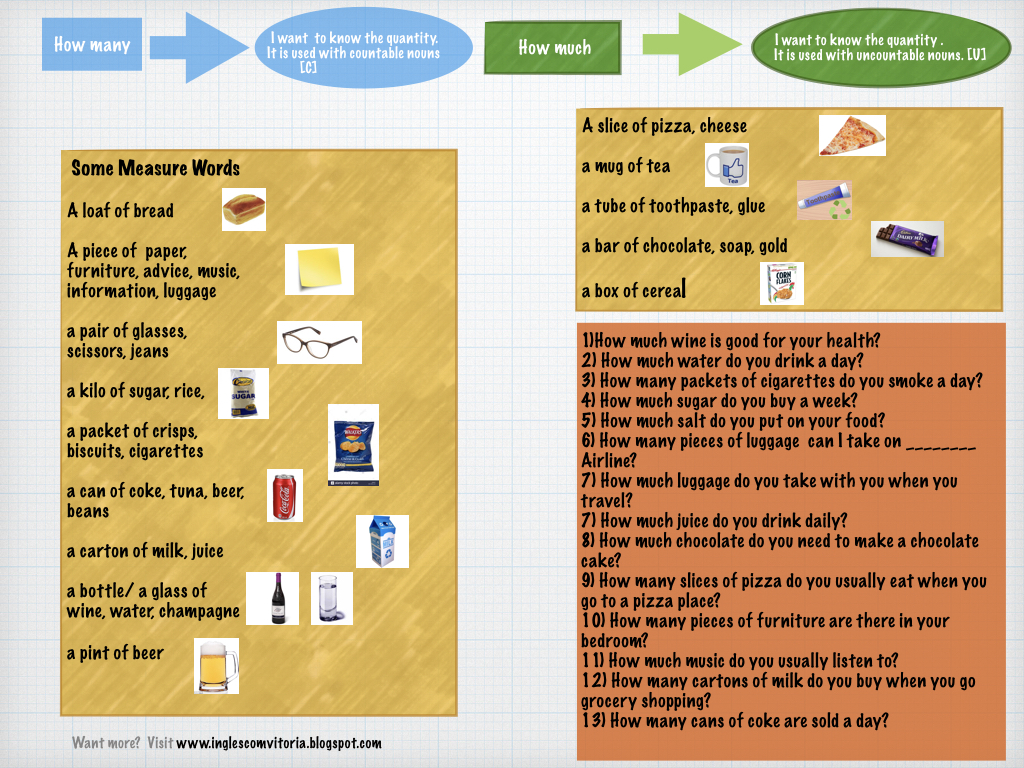
'HOW MANY'/ 'HOW MUCH' / MEASURE WORDS
Is it difficult to use ‘How many’ and 'How much’? If your answer is 'yes', let’s learn to use these quantifiers correctly.
The rule is: we make the difference between ‘how many’ and ‘how much’ by saying that ‘how many' is used with countable nouns [C] and 'how much’ with uncountable nouns [U]. An uncountable noun is not used with "a" or "an" and cannot be made plural. By contrast, a countable noun is used with the indefinite articles (a/an) and can be used in the plural.
Ok, fair enough. But, is it possible to measure uncountable nouns? If so, how? Actually, we can make an uncountable word countable by using measure words (eg. a kilo), or by putting the uncountable noun in a container (e.g, a packet, a bottle).Take for example the following sentences:
How much sugar do you take in your coffee?
How many spoons of sugar do you put in your coffee?
Do you realize that both sentences are correct in English? 'How much' is used in the first sentence because ‘sugar' cannot be counted. However, once we put the word in a container (e.g a spoon), it takes the plural form and it becomes possible to use “How many”.
The diagram above shows the most common measure words in English. Have a look at them and try to answer the questions.
For Portuguese Speakers Only!
Em Português, “How many” e ‘How much” são expressões interrogativas que significam “Quantos/ quantas” e “Quanto”, respectivamente. A tradução já indica que “How many” é usado com substantivos contáveis (veja que o pronome interrogativo está no plural ‘quantos/as' para concordar com o substantivo). Já ‘how much' é usado com substantivos incontáveis. Para quantificar substantivos incontáveis, nós usamos medidas (quilo, colher, etc). Nesse caso, torna-se possível o uso de ‘how many’.
Thursday, 6 April 2017
LEARNING COMPARATIVES AND SUPERLATIVES WITH THE SIMPSONS
Do you have difficulty using Comparatives an Superlatives? If so, you're not the only one. Find out the right way to use them correctly right now.
Summing up, we use the comparative to compare someone/ something with someone/something else. We use the superlative to express that someone/something has more of a particular quality than anyone/anything else.
Have a look at the diagram above and then do the exercises.
Friday, 31 March 2017
Saturday, 25 February 2017
Monday, 6 February 2017
Tuesday, 20 December 2016
Subscribe to:
Posts (Atom)