Total Pageviews

Showing posts with label Collocations/ Fixed Expressions in English. Show all posts

Tuesday, 20 March 2018

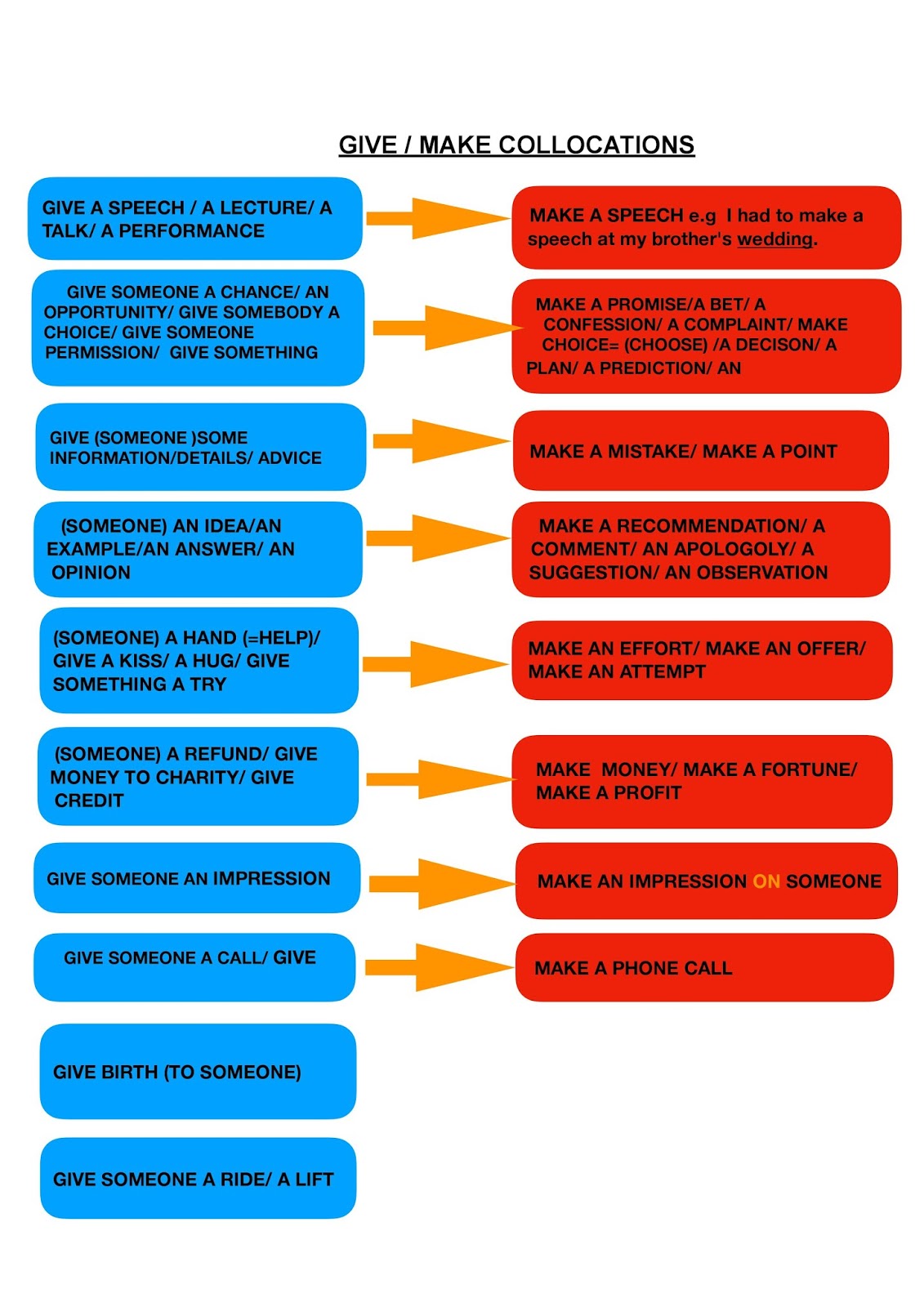
GIVE /MAKE COLLOCATIONS (B2 / C1 Levels)


Becoming aware of collocations is part of vocabulary learning. How well can you use GIVE and MAKE collocations? These two verbs collocate (= go together) with specific nouns and are widely used in everyday speech. Interestingly, we say "give someone a ring/ a call", but we should say "make a phone call'. Likewise, it is correct to say "make a choice" (=choose something), as in "I can help you to make your choice”,  whereas we say "give somebody a choice". e.g "Her doctor gave her a choice: take medicine or lose weight.” The following exercise will give you practice in GIVE and MAKE collocations and can be used both to work in class and as a home assignment. 

PRACTICE

1)Would you _____________ a ride to a stranger requesting one?
2) What does it feel like to __________ a speech to a large crowd?
3) Have you ever __________ the wrong impression to someone you're attracted to?
4) In your opinion, how do I ___________ an excellent first impression on someone ?
5) How can you _____________ suggestions in English?
6) Have you ever ____________ someone a second chance after she/he hurt your feelings? 
7) Is it hard for you to _________________ an apology?
8) Do you prefer texting or __________________ phone calls?
9) If you found 1 million dollars on the street, would you keep it or __________ it back?
10) Would you let your children watch a woman ___________ birth
11) What piece of advice might you________ to someone who wants to learn a foreign language? 
12)What’s the most difficult decision you’ve___________?
13) Have you ever deleted or ________ changes on comments you’ve ________ on facebook?
14) What suggestions would you __________ to improve education in your country?
15) What _____________ you the idea to study English?
16) Have you ever ________________ a hard decision?
17) Have you ever used your consumer rights to _________ a complaint in a shop?
18) is it OK to _________________ mistakes in a foreign language?
19) Is time more important than ____________ money?
20) Do you _______________ friends easily

ANSWER KEY

  1. give; 2) give/ make; 3) given; 4) make; 5) make; 6) given; 7) make; 8) making; 9) give; 10) giving; 11) give; 12) made; 13) made/ made; 14) make; 15) gave; 16) made; 17) make; 18)  make; 19) making; 20) make


Tuesday, 12 December 2017

THE DIFFERENT MEANINGS OF 'BY' IN ENGLISH


Do you have any difficulties in using ‘BY’ in English? If so, don’t worry, because you’re not the only one facing this situation. In fact, its use is so rich and varied that deserves our special attention. Therefore, it’s hight time you learned how to use ‘by' correctly and fearlessly. To make things easier for students of English, I’ve decided to sum up its most common uses in the following explanation. I do hope the diagram above also helps you learn how to use 'by' ‘by heart' ( I’m just kidding!)
If you are a native speaker of Portuguese, have a look at some notes marked with an asterix (*).

1)AFTER A PASSIVE VERB (identifying the agent performing an action. *In Port= por)
e.g ’Romeo and Juliet ‘ was written by Shakespeare.

2)TO EXPRESS TIME

a)To indicate a deadline or the end of a particular time period, no later than.e.g’I’ve got to do this report by Monday’ ( * In Port. = até, antes de)
b)To say that time passes, e.g As time went by, we got used to living there. (* In Port. = com o passar do tempo)
c) With the expression 'by the time’= when. e.g By the time I was 18, I had leant how to speak 3 foreign languages.
d) to say that someone stops somewhere for a short time, mainly with the verbs drop/stop / go by and come by: e.g Why don’t you stop by on your way home from work?Why don’t you drop by for coffee some time?

3) POSITION ( = NEXT TO, BESIDE) 

e.g I live by a football stadium

4)IN PHRASES INDICATING THAT SOMETHING HAPPENED IN A WAY THAT WAS NOT PLANNED.

a) By chance = e.g ’I heard by chance that she is going to get married again’. (* In Port. por acaso)
b) By a stroke of luck - e.g By stroke of luck, I found the perfect name for my shop ( * In Portuguese= por ventura, por um golpe de sorte)
c) By surprise= e.g I was taken by surprise. (* I Portuguese= de surpresa)
d) By mistake/ by accident. e.g Today I took your packed lunch to school by mistake.( In Port. por engano)

5) IN PHRASES INDICATING THAT SOMETHING HAPPENS REPEATEDLY OR PROGRESSIVELY. 

a) little by little/ bit by bit = (In Port.'pouco a pouco ‘)
b) step by step = gradually ( In Port. 'passo a passo’.)
c) day by day = ( *In Port. =dia após dia). He’s getting healthier day by day.

6) TO INDICATE A METHOD (HOW SOMETHING IS DONE) 

a) the means of transport selected for a journey. e.g ’I travelled to Paris by rail’ ( by train, by plane, by car, by taxi, etc.) Remember that when we walk, we should say on foot.
b) by cheque, by credit card , by debit card- e.g “Can I pay by credit card?’ ( but we say in cash)
c)He learned English by watching TV series.  * Note that a typical error made by Portuguese speakers is to omit ‘by'.
d)When we say by + myself, yourself, himself, herself, itself, oneself, ourselves, yourselves, themselves, it means ‘alone’, that is, without anyone's help. e.g 'I did the homework by myself. Note that while we say “by myself’, we say ‘on my own’.
e) By ear. e.g I leant to play the piano by ear.
f)  By hand. e.g When I visited Turkey I bought a rug made by hand
g) By hook or (by) crook= an idiomatic expression which means anyway., by any means, eg. I’ll pass this exam by hook or crook.

7)TO TALK ABOUT MEASUREMENT/ AMOUNT

e.g My salary has increased by 10 %. / Four multiplied by two is eight./Six divided by two is three. This tablecloth measures 175 cms by  250cms (70" x 90").

8)BY THE WAY 

=It is an expression used to add something to what has been said. In Portuguese, ‘by the way’ means “aliás”, “a propósito”,“por falar nisso”. e.g  Do you live in a flat? So do I. By the way, it’s for sale.

9)  WITH  'BY HEART’  WE CAN USE THE FOLLOWING EXPRESSIONS
a) to learn by heart, which means memorize e.g This text is too long for us to leann by heart. 
b) to know by heart , which  means e.g 'The only song I know by heart is 'Angel', by Robbie Williams.

10) BY AND LARGE = ON THE WHOLE, IN GENERAL 
( * in Port. =de modo geral) E.G By and large, I enjoyed my time at school.

11. BY FAR- to give emphasis e. This is by far the most beautiful city I’ve ever bee to.( * In Port. de longe


Monday, 31 October 2016

COLLOCATIONS WITH "GO" (1)


Practice


  1. How often do you go to the beach?
  2. How much do you spend when you go shopping?
  3. What’s the difference between 'going shopping’ and 'going to the shopping centre’?
  4. Do you go to hospital when you have a headache? 
  5. Do you have to go to the bank nowadays?
  6. Who do you go to the cinema with?
  7. Do you like going for a walk? 
  8. Why do you go to the gym?
  9. How do you go to work
  10. Which do you prefer: going surfing or going swimming?
  11. Where do you usually go on holiday
  12. How often do you go to church
  13. How long does it take to go to the city centre?
  14. How far is it to go to the park?
  15. Do you prefer going for a ride or for a drive
  16. Where do you usually go for a drink
  17. Would you like to go abroad
  18. What time do you go to work/ to school every day?
  19. What time do you usually go home
  20. What do you do to keep fit? Do you go to the gym or do you go jogging?
  21. What time do you usually go to bed?

Tuesday, 27 September 2016

COLLOCATIONS WITH ''DO''/ GAME


Rules:
  1. Get started
  2. When you lend on a square", fully answer the question
  3. Everyone can ask follow up questions anytime.
  4. Picture box: the player must ask a question to another player by using the collocation shown in the picture
  5. The winner is the player who reaches the “Finish” first.

Game with ''Do''

''Do'' Material

Comments system

Disqus Shortname