Um blog de inglês para estrangeiros, principalmente para falantes de língua portuguesa. Aprimore seus conhecimentos de vocabulário (collocations, slangs, idiomatic expressions), pronúncia, gramática. O blog também é voltado para aqueles que procuram ideias para o ensino de inglês como língua estrangeira.
Total Pageviews
Showing posts with label Let's sing! (Inglês através da Música). Show all posts
Showing posts with label Let's sing! (Inglês através da Música). Show all posts
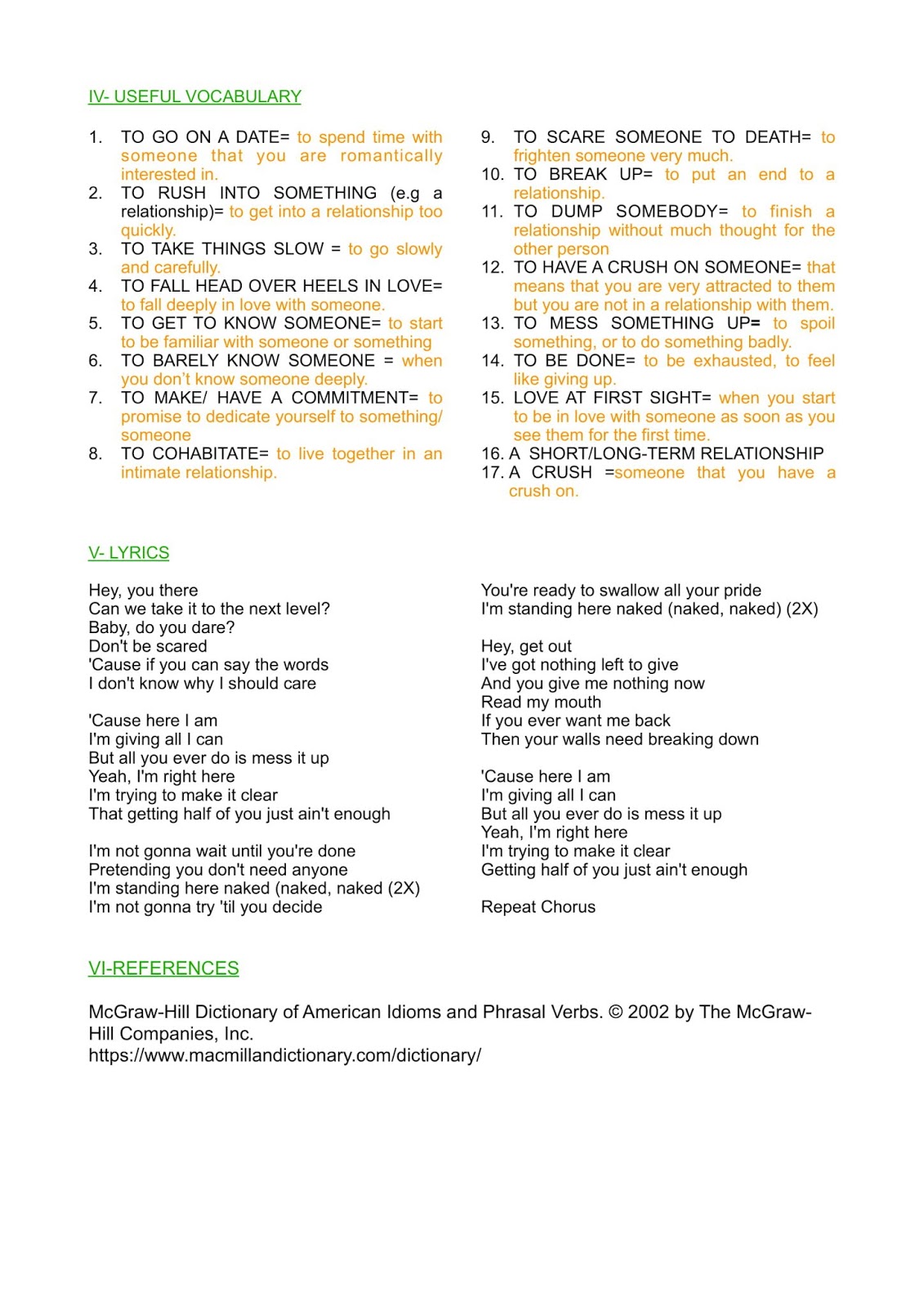
This song worksheet is divided into different tasks and should be used to help students talk about love relationships and commitment. That’s why a glossary has been added. Students listen to the song, choose the correct word, match the sentences and then use context to guess meaning. Suitable for intermediate and upper- intermediate levels.
Phrasal verbs are verb phrases that have idiomatic meanings. Because what is meant is not obvious from the individual words that make up the phrase, students of English often find the topic very confusing. In other words, ‘phrasal verbs' don't seem to make any sense! Whether it is true or not, you can’t be proficient in English without using multiword verbs, right?
All things considered, I’ve devised a song worksheet to help students learn phrasal verbs in context. The song is called ‘Photograph’, by Nickleback, and talks about our younger years, or better, it is sheer nostalgia.
The worksheet can be used not only to encourage students to talk about their memories, but also to help them grasp the meaning of several phrasal verbs.The tasks may be used with both intermediate and post-intermediate students. Learners are expected to fill in the gaps, do a matching exercise, learn new vocabulary and sing along with the lyrics.
Do you know the difference between content and function words in English? Why should learners of English learn about that?
Content words are words that have meaning. Nouns, main verbs, adjectives and adverbs are usually content words, so they tend to be highlighted in the sentence. In other words, content words are stressed words and, therefore, are pronounced more loudly or with greater force than other words in a sentence.
By contrast, function words, also known as grammatical (structural) words are often unstressed, that is, not emphasized. Auxiliary verbs, pronouns, articles, and prepositions are usually grammatical words and, therefore, are pronounced in a reduced form.
All in all, why should we know that? This difference will undoubtedly help you improve your listening skills, and I should say that improving listening skills must be a top priority for anyone who wants to become really good at speaking a foreign / second language.
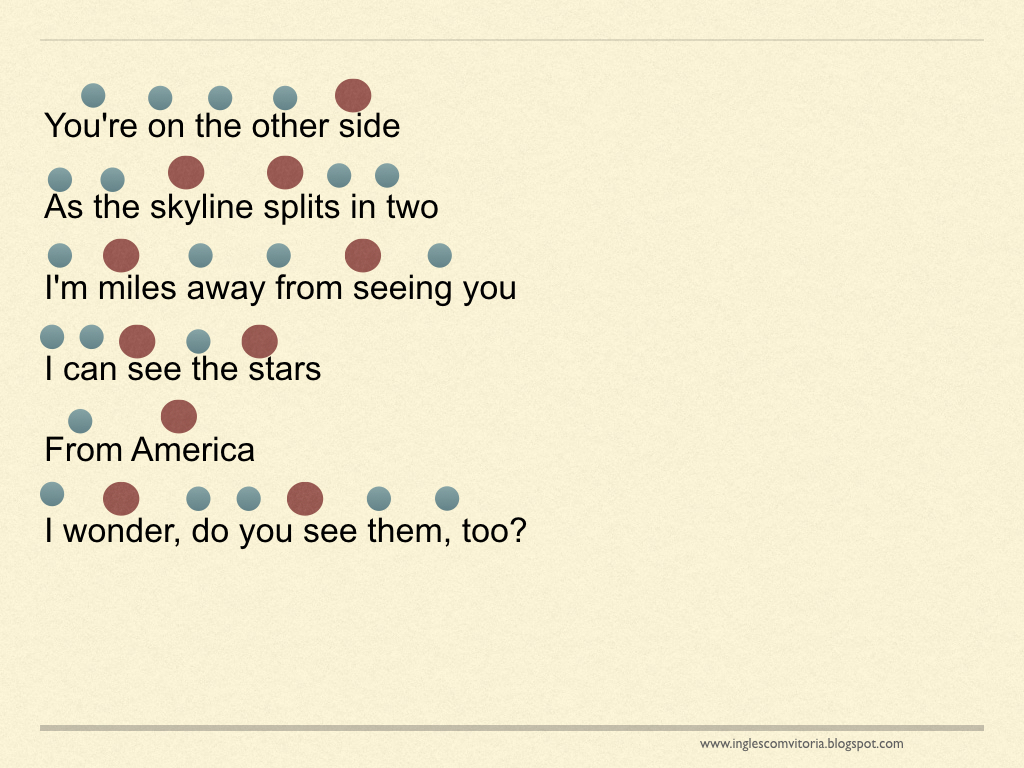
In order to practise this pronunciation topic, I have chosen a famous song “ All the stars’, by Ed Sheeran, because we can clearly hear the stressed and unstressed words in connected speech. We can see two different colours and sizes to simbolise the stressed and unstressed words in each verse.
For teachers
Learning how to notice the difference between stressed and unstressed syllables can be rather difficult and it is far form being an easy task for non-native teachers of English If you are a teacher of English, use this helpful resource to teach your students how to identify whether or not a syllable is stressed or unstressed in a song. By doing so, your students will definitely enjoy working on pronunciation.
Give out the copies of the song.
Read the first stanza aloud to demonstrate the stress patterns. Explain that the bigger/red circles will be the content words as opposed to the grammatical words (smaller/ blue circles and unstressed)
Split the class into two groups and ask each one to read the second and third stanzas paying close attention to the stress patterns. If necessary correct pronunciation errors/ mistakes.
Later, play the song so that the students can do the task while listening to the singer.They are expected to mark the stressed and unstressed words as shown. If necessary, play the song more than once.
Alternatively, do pair work activity and ask 'Student A’, for example, to dictate the fourth stanza to 'Student B’. It will be a further pronunciation practice for the student who is dictating and a listening activity for that who is listening. Then, play the song.
If the students do not have colour pens, they can make big/small circles as shown.
Sing along!
For students
If you are a learner of English, follow my guidelines above and do the task on your own known, OK?
Are you into music? Well, I am, and I love using songs in my lessons. I must say that pop songs put our students in touch with real English and make learning fun.
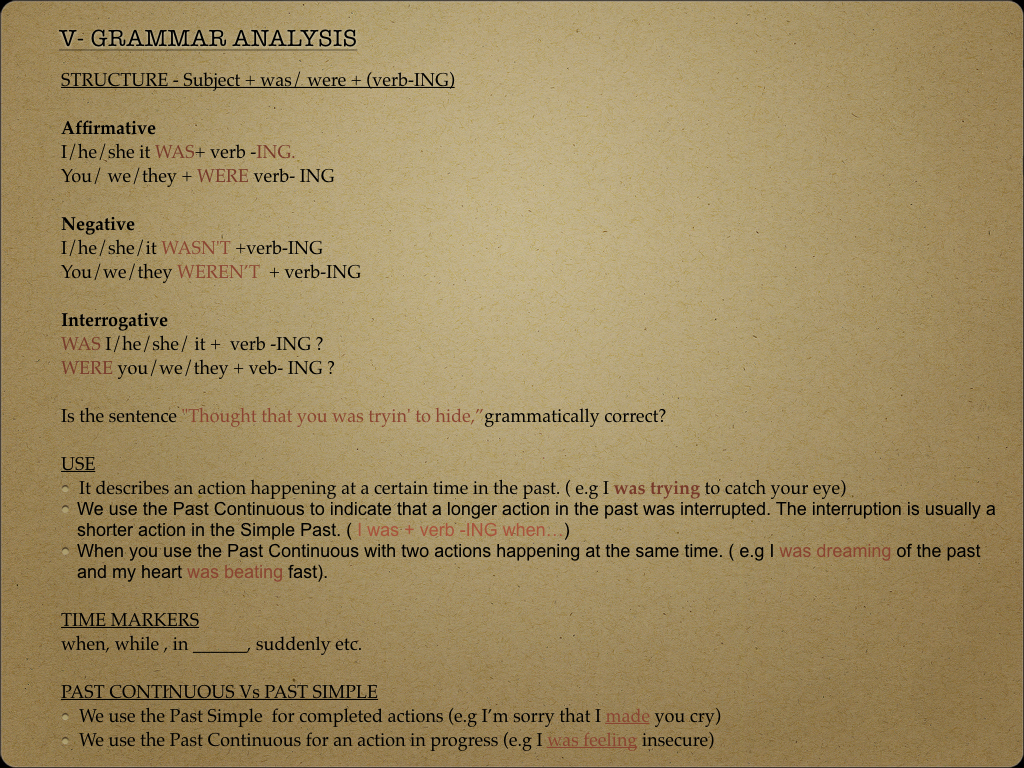
This is a worksheet of the song "Jealous Guy", by John Lennon. If you are an English student, you can make use of this activity to learn about the Past Continuous. On top of that, I have prepared pre- listening questions to help you understand the content of the song and improve your speaking skill, as well. I do hope you like the material.
Teacher's Notes
If you are a teacher, you may find the following notes useful.
Pre-listening Activity
Ask students to answer the questions in pairs or small groups. Ask them to look at the pictures shown to help them predict the content of the song. Encourage students to talk as much as possible.
While-listening Activity
Play the song and ask students to do the tasks as written. Explain that each exercise contains the verses of the song.
Post-listening Activity
Students read through the grammar analysis which focuses on the Past Continuous. Ask students to make their own sentences. Ask questions like: What's the difference between the Past Simple and the Past Continuous? If you favour time lines to teach verb tenses in English, draw them on the board.
The Corrs are an Irish band consisting of siblings (three sisters and a brother). They became very popular during the 1990’s playing a blend of pop, rock and Irish traditional music. ‘What can I do’, from the album ‘Take on Corners’ became one of the band's most known hits worldwide. Personally speaking, the Corrs have proven to be one of the best and most successful bands to come out of Ireland since U2 in the early 1980's.
When I use music in my classes, I want my students to go beyond just listening to the song. Actually, I want them to develop their speaking skill by analyzing the song lyrics. This activity allows the students to look more closely at the meaning of “What can I do’, by the Corrs, which talks about ‘unrequited love”.
The song worksheet is appropriate for both pre-intermediate and intermediate students.
For Students:
Listen to the song and do the tasks.
For teachers:
Pre-listening
Warm up students by asking them about what they already know related to the song/ band. You can ask questions as 'Who sings this song?' 'What’s the meaning of ‘unrequited love'?
While-listening
Hand out the worksheet and ask students to carry out the tasks. Then check answers with them.
Você se importa com o que as pessoas pensam sobre você? É comum nos incomodarmos com a opinião dos outros, mas não deveríamos, concordam? Pensando nisso, resolvi fazer um “post" ensinando vocês a dizer que “Não estão nem aí”, ou seja, que estão pouco se lixando com aquilo que falam de você.
Listo, abaixo, algumas das possíveis maneiras de dizer que você pouco se importa com algo, marcando com um * aquelas ainda mais coloquiais e, até mesmo, um pouco ofensivas. Assim, a escolha de qual expressão usar depende da situação, ok?
I don’t care ( at all) ( =Não me importo
I don’t mind
I couldn’t care less
I don’t give a damn * (=Tô me lixando!)
I don’t give two hoots
I don’t care a straw (= não dou a mínima.)
I don't give a shit* / (= Tô nem aí.)
I don’t give a crap*
I don’t give a fuck** = (Eu quero é que se foda!)
Em seguida, remeto os leitores ao link do material incluso em PDF, onde trago uma música da cantora Ariana Grande, cujo título é “I don’t care”. Bem sugestivo, não é? No worksheet que preparei, pode-se trabalhar pronúncia, as expressões que exprimem “Tô nem aí” e o tópico gramatical “USED TO". Vale a pena conferir!
Used to cry/ try 'bout some crazy shit/ sheet before
I used to feel/ fill so obligated to be so much more
I used to let some people tell me
How to live/ leave and what to be
But if I can't be me
Then what's the point?
No
I don't care/ tear about it anymore, oh
I don't care/ fear about it anymore
II- Put the verses in the correct order
( ) Like what do you think?
( ) Used to have a hold
( ) That used to be important to me
( ) Used to have a hold on me
( 1) Now I laugh about the things
( ) And what he thinks and what they think
( ) But I love me
I don't care about it anymore, oh
I don't care about it anymore
Yeah
I-I-I
I-I-I don't care about it anymore
I-I-I don't care about it anymore
III-Look at the expressions below. What do they express? Can you see any difference among them?
I don’t care ( at all) ( =Não me importo)
I don’t mind
It doesn’t matter (= Não tem importância)
I couldn’t care less
I don’t give a damn, (=Tô me lixando!)
I don’t give two hoots
I don’t care a straw (= Não dou a mínima.)
I don't give a shit* / (= Tô nem aí.)
I don’t give a crap*
I don’t give a fuck * ( = eu quero que se foda!)
IV- Used to
(+)I used to live in Rio de Janeiro when I was a kid.
(?)When you were younger, did you use to care about what people thought about you?
(- ) As a child I didn’t use to eat salad but now I love it
We can use ‘used to’ to talk about past states or repeated past actions
•I used to smoke but I gave up a few years ago.
Portuguese Interference!
Remember that ‘used to’ is only for past states/actions/ habits. We can’t use it for things that still happen now. ( Used to é só usado no passado. Assim, em inglês, não dizemos “eu costumo a fazer algo", e sim, eu faço, ok?
My kids never used to argue, but now they argue ( Not Use to argue) all the time.
In the past, I used to care about what people thought about me, but now I don’t care about it anymore.