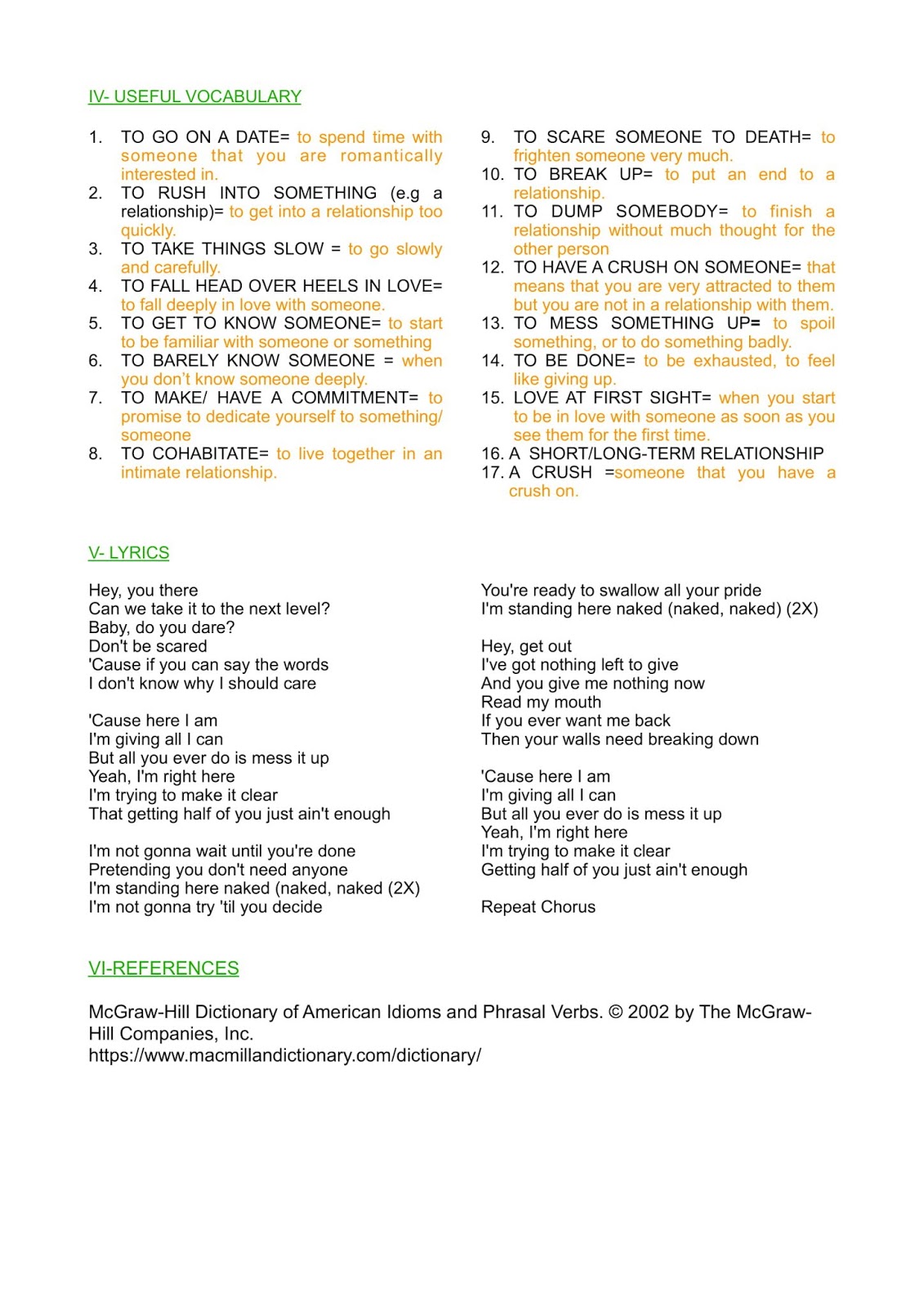
This song worksheet is divided into different tasks and should be used to help students talk about love relationships and commitment. That’s why a glossary has been added. Students listen to the song, choose the correct word, match the sentences and then use context to guess meaning. Suitable for intermediate and upper- intermediate levels.
Um blog de inglês para estrangeiros, principalmente para falantes de língua portuguesa. Aprimore seus conhecimentos de vocabulário (collocations, slangs, idiomatic expressions), pronúncia, gramática. O blog também é voltado para aqueles que procuram ideias para o ensino de inglês como língua estrangeira.
Total Pageviews
Showing posts with label Improving your speaking skill. Show all posts
Tuesday, 20 November 2018
Thursday, 27 September 2018
Wednesday, 16 May 2018
HOW ABOUT LEARNING PHRASAL VERBS WITH A SONG?
Phrasal verbs are verb phrases that have idiomatic meanings. Because what is meant is not obvious from the individual words that make up the phrase, students of English often find the topic very confusing. In other words, ‘phrasal verbs' don't seem to make any sense! Whether it is true or not, you can’t be proficient in English without using multiword verbs, right?
All things considered, I’ve devised a song worksheet to help students learn phrasal verbs in context. The song is called ‘Photograph’, by Nickleback, and talks about our younger years, or better, it is sheer nostalgia.
The worksheet can be used not only to encourage students to talk about their memories, but also to help them grasp the meaning of several phrasal verbs.The tasks may be used with both intermediate and post-intermediate students. Learners are expected to fill in the gaps, do a matching exercise, learn new vocabulary and sing along with the lyrics.
Listen to the song by getting access on https://www.youtube.com/watch? Have fun!
Monday, 12 March 2018
HOW DO YOU SPEND YOUR TIME ( B1 LEVEL)
FOR STUDENTS
Make sure you understand the words in the table. imagine you are meeting someone for the first time. Ask the question ‘How do you spend your time?' In this activity you are going to learn how to keep a conversation going. Student B should answer the question in detail, and student A is expected to ask follow up questions. Use the phrases provided, but try to add your own ideas.
FOR TEACHERS
Give students time to prepare what they are going to say and ask you for any vocabulary they do not understand. Encourage them to fill in each category with the words given as well as the vocabulary they already know. Encourage them to use the phrases provided, but emphasise that they can add their own ideas if they want. Explain that to carry out the task, they should try to find out as much as possible about each other.
They should make notes to help them when they report back to the class. As they interview each other, feed in any language they need in an informal way and refer them to the phrases provided. Do not correct at this stage unless absolutely necessary, as this will interrupt communication. Note down errors with language used for analysis at the end of the task.
Wednesday, 7 March 2018
TALKING ABOUT (UN) HEALTHY LIFESTYLES
This a a conversation lesson about (Un)Healthy Lifestyles. You should try to find out as much as possible about your partner. Ask and answer the questions and whenever possible, make your own to keep the conversation going. Refer to the phrases in Useful Vocabulary, but add your own ideas if you want.
As a warm up activity, brainstorm words/ expressions you already know about the topic. Later on, fill in the word map according to the questions and list of vocabulary provided.
STUDENT A
- Do you think you have a healthy life style? Justify
- Are you an early bird or a night owl? Do you think that you sleep too much or not enough?How many hours' sleep do you need daily? What happens when you do not get enough sleep?
- Is it possible to have a healthy life style nowadays? How has technology affected our lifestyle?
- Do you pay attention to what you eat?
- Do you have a snack every time you are hungry or do you wait for the lunch or dinner? What is better for health?
- What should you do to burn calories and fight fat?
- Do you agree with the saying: "Eat your breakfast, share your lunch with a friend and give your dinner to your enemy”?
- Have you ever tried to go on a diet? Did it work?
- Is there any connection between the person's style of life and life expectancy? Quote a few changes you can make in your lifestyle to help you live longer.
- How often do you work-out?What are the benefits of physical activity such as jogging, going to a gym, or swimming?
___________________________________________________________________________
STUDENT B
- How do you usually cope with stress? What is the effect of stress on health?
- Do you have any unhealthy habits? Do you skip any meals?
- Do you think people have become more health conscious in recent years?
- Do women pay more attention to their health than men? How often do you get a medical check-up?
- Why do you think some people continue bad habits when they know that they are causing damage to their health?
- What are the most popular ways of keeping healthy in your country?
- In your opinion, how can parents encourage healthy habits?
- Do you feel guilty after eating junk food? (pieces of chocolate cake, scoops of ice cream or handfuls of chips,)? If so, what do you do to wash away this feeling?
- In your opinion, do pets have a positive or negative influence on people’s health? Why?
- What do people generally believe about (un) healthy lifestyles?
USEFUL VOCABULARY
Colloquial Language/ Personality Traits
a fitness freak (=obsessed with sport and fitness)
a couch potato (=a person who spends little or no time exercising and a great deal of time watching television.)
a live-wire (an energetic person)
a calorie- counter (=someone who counts calories is one way to monitor weight loss.)
an early bird = (a person who gets up early.)
a night owl= (a person who often stays up late at night.)
a couch potato (=a person who spends little or no time exercising and a great deal of time watching television.)
a live-wire (an energetic person)
a calorie- counter (=someone who counts calories is one way to monitor weight loss.)
an early bird = (a person who gets up early.)
a night owl= (a person who often stays up late at night.)
Important Verbs/ Collocations
to be health conscious
to damage someone’s health
to do good x to do bad (= to do harm) to your health
to keep/ get fit
to have regular physical exercise
to stop + Verb ING ( e.g to stop smoking) = to quit
to improve/ to enhance ( e.g self-esteem, memory)
to reduce the risk of… (e.g stress, symptoms of anxiety and stress)
to prevent (e.g heart disease)
to have a healthy lifestyle
to have a sedentary lifestyle
to get involved with sports and outdoor activities
to feel guilty
to lose weight
to go on a diet
to set an example
to release (e.g energy, hormones)
to be on the go (= to be always busy)
to burn calories
to be addicted to sth
Phrasal Verbs
to work out ( =to exercise in order to improve the strength or appearance of your body:
to cut down or cut back =to start doing less of something, especially because it is bad for your health e.gThe doctor advised him to cut down (on) his working hours.
to cut out= to stop eating something or doing something, especially because it is bad for your health e.g.I’ve cut out chocolate completely.
to put on weight = to gain weight
Nouns/ Noun Phrases
- a balanced diet
- physical and psychological well-being
- health/ unhealthy habits
- junk food
- fastfood
- obesity
- overweight
- weight gain/ loss
- calorie
- longevity/ life expectancy
- will-power/ determination/ motivation
- vitamin supplement
- fattening foods
- metabolism
Nutrients
- protein
- carbohydrate
- fat
- sugar
- vitamins
- minerals
Kinds of diet
- the low-carb diet.
- the detox diet
Health problems:
- diabetes
- cholesterol
- stroke
- heart disease
- high blood pressure
- eating disorders
- depression
- stress
- anxiety
Thursday, 18 January 2018
DON'T YOU THINK YOU SHOULD USE OTHER WORDS APART FROM 'HAPPY' AND 'SAD' ?
Thank God 2017 is finally over. Wishing you all the best in 2018!
Today I’m over the moon, because two of my children, who are also my students of Englsih, have passed Cambridge Exams. Now, it is time to snap out of my bad mood and start February in high spirits. Do you understand the idiomatic expressions I’ve just used? They convey happiness.
Do you realize that I’m using other ways to say happy in English? Well, if you want to speak better English, you need to expand your vocabulary, OK?Start your English conversation by answering the questions below. If you don't have a conversation partner, think about how you would answer each question with complete English sentences.
TALKING ABOUT HAPPINESS/ SADNESS
- What is happiness for you?
- In your opinion, can money buy happiness?
- What do you usually do to feel happier?
- Is happiness relative, that is, does it have a different meaning for each person?
- Do pets play an important role in our lives?should they be seen as valuable contributors to human health and wellbeing?
- When did you last feel very happy? What happened?
- How do you show your happiness? Do you share it with others or keep it private?
- Which country has the happiest people in the world? Which has the saddest? Why is it so?
- Were you happier as a child than as an adult? Why or why not?
- Are you happy all the time or is happiness a state of mind?
- Are the things that make people happy today the same as several decades ago?
- In general, what do you think makes a happy family?
- In English we say “ignorance is bliss". Do you agree? If ignorance is bliss, is knowledge pain?
- What is missing in your life that would make you very happy?
- Are married people happier than singles?
- Does religion make people happy?
- If you could give a piece of advice to someone about being happy, what would it be?
- Does happiness change with age?
- What was the most recent situation or activity in which you experienced the most happiness?
USEFUL VOCABULARY
- In high spirits= If someone is in high spirits, they are extremely happy and having a good time: e.gThey’d had a couple of drinks and were in high spirits.
- To be over the moon= to be very pleased: e.g She was over the moon about/with her new car
- On cloud nine= In a state of extreme, euphoric happiness. e.g Ever since Mary got her promotion at work, she's been on cloud nine.
- Walking on air – To feel elated and so happy that you could float. e.g She was walking on air when she got the job.
- On Top of the World – Not only does this talk about happiness, but it can also specifically talk about the happiness we get from being successful.e.g He was on top of the world after winning first prize
- To Jump for Joy – To be very happy. e.g.I jumped for joy once I found out I had been chosen to be in the team
- glad= pleased and happyI.e.g.I 'm glad (that) you came.
- happy
- content= happy or pleased with the situation
- satisfied= happy because you have what you need e.g I’m, satisfied with my job.
- cheerful =Someone who is cheerful is happy and shows this in their behaviour.
- elated= extremely happy and excited, often because something has happened or been achieved:e.g He was elated at/by the birth of his son.
- pleased= happy or satisfied:
- delighted =very pleased:a delighted audience. e.g Pat was delighted with her new car.I was delighted at/by your news.
- thrilled =very excited, happy, and pleased
- overjoyed= extremely happy
- euphoric= elated
- joy= great happiness:= e.gThey were filled with joy when they got married.
- bliss= perfect happiness: e.g Lying on a sunny beach is my idea of sheer bliss.
- euphoria= a noun that refers to extreme happiness
If you’re feeling down, here are some suggestions on how to express sadness.
- sad (adj) / sadness (n)
- upset = unhappy, worried and emotionally troubled
- miserable = very unhappy.She went to bed, miserable and depressed/misery (n)
- (down) in the dumps= unhappy: e.g.She’s down in the dumps because she failed one of her exams
- to feel blue= to feel sad. e.g You look like you feel blue. What's wrong?
- to get someone down= to make someone unhappy e.g This terrible weather gets me down
Tuesday, 28 November 2017
SPECULATING ABOUT THE FUTURE
If only we could accurately predict the future! … Until a crystal ball is invented, our predictions can only be guided by speculation.
When we speculate about the future, we try to guess about the possible causes or effects of something, without knowing all the facts or details.
In foreign exams, the examiner will probably ask you to talk about what you think will happen in the future or how things will change in the future. Here are some phrases you can use:
Now, it’s your turn. Answer the following questions by using the sentence patterns provided above.
EXPRESSING CERTAINTY
I'm sure/I'm convinced that …
I doubt that …
No doubt…
I daresay…
I bet / you can bet (that)
I’ll definitely/ I definitely won't…
I’m bound to…
There’s no way…
There's no chance of…
EXPRESSING LIKELIHOOD
It is (highly) likely that ...
It is (highly) probable that ...
It is unlikely/improbable that ...
It seems likely/unlikely/improbable that ...
I’ll probably / I probably won’t…
EXPRESSING POSSIBILITY
I haven’t decided yet. I reckon I’ll …
I’m not quite sure, but I may/ might/ could
I haven’t got a clue, but perhaps…
I expect/ I suppose (that)
I hope I’ll/ won’t …
I guess/ I think/ I reckon…
My guess is that …
I imagine (that) …
I wouldn't be surprised if …
Now, it’s your turn. Answer the following questions by using the sentence patterns provided above.
What do you think will happen next year?”
Where do you see yourself in 5 years’ time?
Do you want to study abroad?
When do you think you will finish your studies?
How will computers change in the future?
How will cellphones change in the future?
How will transportation develop in future time?
Will Uber change anything?
How long will humans live?
What kind of developments might happen in health care in the future?
Could there be another world war in the future? How can we prevent a world war from happening?
If you don't like your job now, What is the job you would like to have in future?
What will education be like in the future?
What will the cars of the future do?
What will future houses look like?
Do you think the future will be better or worse for your grandchildren? In what ways?
Would you like to live on another planet?
Will robots replace humans?
What type of job would you like to do in the future?
Do you think life will be more difficult or easier for our grandchildren? In what ways?
How do you think your country will change in the future?
Tuesday, 21 November 2017
TALKING ABOUT FRIENDSHIP
Hello, everyone! How are you today? I hope you’re OK. In this EFL lesson, we’re are going to look at some vocabulary related to friendship.
Both at intermediate and advanced EFL levels, a lesson having to do with friendship can be useful as well as interesting if we consider engaging students in conversation. However, how can we talk without knowing the appropriate words?
Here is a list of words and expressions you will need to activate your vocabulary. Late on, have fun with the most commonly asked questions about friendship.
Talking about Friendship- Useful Vocabulary
- to get on well= get along
- to hang out e.g I like to hang out with my friends as much as possible.
- to drift apart: to become less close to someone. e.g As years went by, school friends drifted apart.
- to get to know each other = to start to be familiar with someone
- to have a lot in common
- to hit it off=If two people hit it off, they like each other and become friendly as soon as they meet.[informal]They hit it off straight away, Daddy and Walter.How well did you hit it off with one another?
- to meet up= to come together with someone, either unexpectedly or as planned. We usually meet up for a quick coffee in the morning.
- to fall out (with someone)= o stop being friendly with someone because you have had a disagreement with them. e.g. Have you two fallen out?
- to make up= to become friends again.
- to keep in touch with someone: to maintain contact with someone. eg.I keep in touch with my friends from high school, although we graduated five years ago.
- to lose touch with someone: to lose contact with someone.I lost touch with Mary since she moved to Canada.
- a shoulder to cry on: someone who listens to your problems It's always good to talk to Hilary, she's so sympathetic. She's a real shoulder to cry on
- to strike up=to start. (a conversation, a relationship): e.g. I feel awkward when I strike up a conversation with unknown people.
- to get on like a house on fire: people get on like a house on fire when they like each other's company and become friends very quickly.
- be like chalk and cheese= (uk)If two people are like chalk and cheese, they are completely different from each other:My brother and I are like chalk and cheese.
- to bury the hatchet: to stop fighting or quarrelling
- to spend time with
- two-faced= a person who says he/she does or believes one thing when his/her behaviour or words show that they do not do it or do not believe it.
- trustworthy= loyal
- sympathetic= understanding
- genuine= true friend
- fair-weather friend: someone who is your friend only when you are cheerful and successful.A lot of John's friends turned out to be fair-weather friends. They were with him when he was rich and left him when he went bankrupt.
- good / close / best friend
- acquaintance= someone you know slightly
- colleague= someone you work with
- flatmate= someone you share a flat with
- partner= someone you have a business with/ a relationship with
- companion= a person employed to assist, to travel or to live with another person. ( In Port. = acompanhante)
- pal= close friend in coloquial English.
- buddy= friend in colloquial American English.
- mate= friend in colloquial British English
- chum= old fashioned word for friend in British English.
- cyberfriend= friend we communicate with through the internet
- frenemy= a person who pretendes to be your friend, but is in fact en enemy. In Portuguese, it means "amigo da onça”.
- 35.childhood friends = friends you grew up with.
Conversation Questions
- What do you usually do with your friends?
- Do you make friends easily?
- Who is your best friend? How long have you known each other?
- Do you prefer to have many friends or just a few that you are close to?
- What qualities are most important to you in a friend? Honesty? A sense of humour? Something else?
- How do you keep in contact with friends who don’t live near you? How difficult is it to keep in touch? Have you ever lost contact with a friend?
- What are the benefits of having just a few close friends? How about the benefits of having many friends?
- Describe your best friend. (What does he/she look like?)
- Are you close friends with anyone who you knew in elementary school?
- Do you have any friends who would risk their life to save you?Would you risk your life to save a friend? How about a stranger?What is the biggest thing you have done to help a friend?
- What kind of qualities do you look for in a friend?
- What is the best way to make new friends? Do you like making new friends?
- How did you meet your best friend?
- Do you keep in touch with your long-distance friends?
- Are friends sometimes more important than family?
- Have you ever fallen out with a friend? If so, what happened? Did you make up later?
- Are your childhood friends those you have strongest bonds with?
- At which stages of life is it easier to make friends?
- How similar are you to your friends?
- Do you think a man and a woman can really be "just friends”? Justify
- Do you think it's possible to be a good friend of an ex-husband or wife?
- Do you have many friendships which have lasted since childhood?
- Do you think sites like Facebook are good for friendships or do they stop people from becoming close?
- Have you made some friends over the internet?Have you ever met this person face-to-face?
- Many people now have hundreds, or even thousands, of cyberfriends on Facebook.
- How many genuine friends do you think someone can really have?
Subscribe to:
Posts (Atom)