Total Pageviews

Showing posts with label Pronunciation Tips. Show all posts

Monday, 26 June 2017

CONTENT AND FUNCTION WORDS IN ENGLISH. WHY SHOULD LEARNERS OF ENGLISH LEARN ABOUT THAT?


Do you know the difference between content and function words in English? Why should learners of English learn about that?

Content words are words that have meaning. Nouns, main verbs, adjectives and adverbs are usually content words, so they tend to be highlighted in the sentence. In other words, content words are stressed words and, therefore,  are pronounced more loudly or with greater force than other words in a sentence. 

By contrast, function words, also known as grammatical (structural) words are often unstressed, that is, not emphasized. Auxiliary verbs, pronouns, articles, and prepositions are usually grammatical words and, therefore, are pronounced in a reduced form. 

All in all, why should we know that? This difference will undoubtedly help you improve your listening skills, and I should say that improving listening skills must be a top priority for anyone who wants to become really good at speaking a foreign / second language.

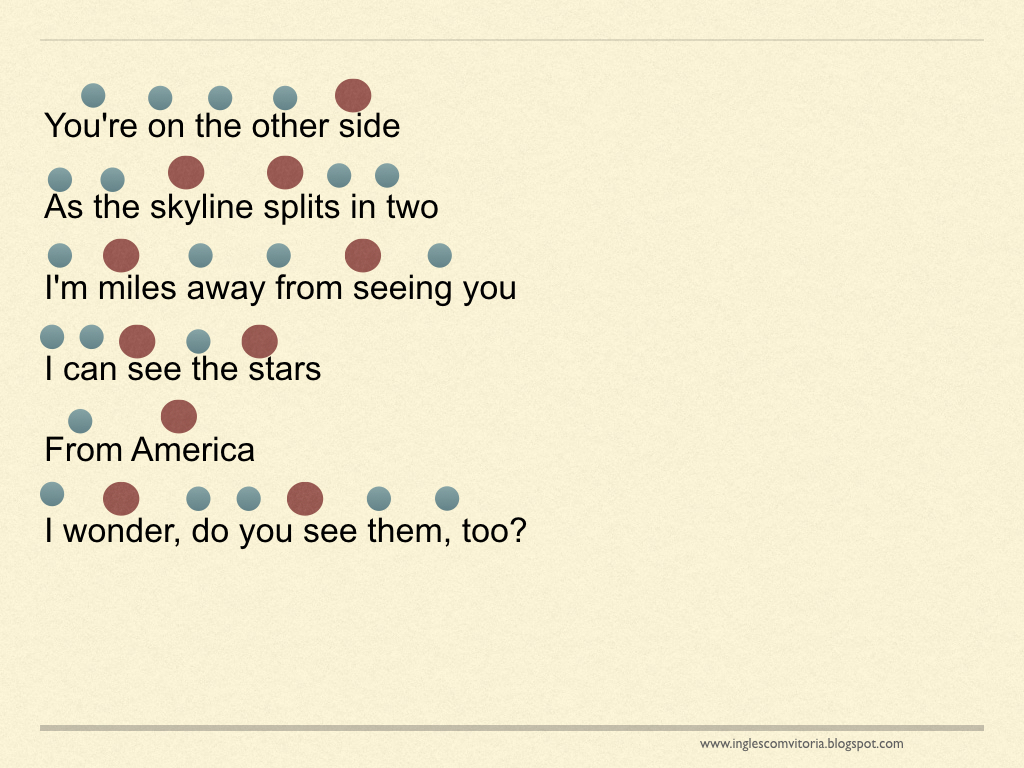
In order to practise this pronunciation topic, I have chosen a famous song “ All the stars’, by Ed Sheeran, because we can clearly hear the stressed and unstressed words in connected speech. We can see two different colours and sizes to simbolise the stressed and unstressed words in each verse. 

For teachers

Learning how to notice the difference between stressed and unstressed syllables can be rather difficult and it is far form being an easy task for non-native teachers of English  If you are a teacher of English, use this helpful resource to teach your students how to identify whether or not a syllable is stressed or unstressed in a song. By doing so, your students will definitely  enjoy working on pronunciation. 

  1. Give out the copies of the song. 
  2. Read the first stanza aloud to demonstrate the stress patterns. Explain that the bigger/red circles will be the content words as opposed to the grammatical words (smaller/ blue circles and unstressed)
  3. Split the class into two groups and ask each one to read the second and third stanzas paying close attention to the stress patterns. If necessary correct pronunciation errors/ mistakes.
  4. Later, play the song so that the students can do the task while listening to the singer.They are expected to mark the stressed and unstressed words as shown. If necessary, play the song more than once. 
  5. Alternatively, do pair work activity and ask 'Student A’, for example, to dictate the fourth stanza to 'Student B’. It will be a further pronunciation practice for the student who is dictating and a listening activity for that who is listening. Then, play the song.
  6. If the students do not have colour pens, they can make big/small circles as shown.
  7. Sing along!

For students

If you are a learner of English, follow my guidelines above and do the task on your own known, OK?


Tuesday, 18 October 2016

COMO PRONUNCIAR PALAVRAS COM 'OUGH' EM INGLÊS


Oi, Pessoal! Hoje escolhi dar uma dica de pronúncia. Vejam como as palavras com 'OUGH' possuem escrita semelhante, mas pronúncias bem diversas. Pois é, infelizmente, não há regras e, portanto, é só na prática que aprendemos a dizer essas palavras corretamente. Se vocês quiserem escutar a pronúncia de cada palavra listada abaixo, os remeto aos sites de alguns dicionários como, por exemplo, o www.dictionary.cambridge.org. Vejam que para cada grupo, fiz alguns comentários.


1/ɔ:/ 2/ɒf/ 3/ʌf/ 4/əʊ/ 5/u:/
bought /bɔ:t/
brought/brɔ:t/
thought /θɔ:t/
fought /fɔ:t/
caught /kɔ:t/
ought /ɔ:t/
cough/kɒf/
rough/rʌf/
tough/tʌf/
enough/ɪˈnʌf/
Dough /dəʊ/= massa
though /ðəʊ/
although /ɔ:lˈðəʊ/
through/θru:/
throughout
/ θru:aʊ t/


  1. Essa pronúncia é bem comum com alguns verbos no ‘Simple Past’ e “Past Participle”. Devemos pronunciar essas palavras com um longo ‘o’ e  o ‘ugh’ fica mudo. Elas rimam com ‘hot’. É importante percebermos que o ‘t’ final é pronunciado. Os falantes de língua portuguesa devem tem cuidado para não pronunciar esse ‘t’ final como se tivessem pronunciando o som de /tʃ/, como em tia, nem tampouco colocarem a vogal /i/ no final da palavra. E.g The skirt I bought (= passado de comprar) was too short.
  2. Rima com a preposição ‘off’. E.g. I’ve got a terrible cough (=tosse)
  3. Rimam com ‘puff’. I haven’t got enough money to by a new car. The examination was tough (= difícil, árduo). O ‘gh’ fica com som de ‘f’.
  4. Rima com ‘go’. O ‘gh é mudo. Although (= embora) it was raining, we went to the beach.  Vê-se também a escrita "donut" em vez de "doughnut". To make bread we have to roll the dough (= massa) with a roller.
  5. Rima com ‘too’. Through (=através) e throughout : e.g. I check e-mails thoghout the day. E.g. We walked slowly through (=através) the gates of the park.  Já é possível encontrarmos, no inglês americano, uma simplificação na ortografia de algumas palavras como, por exemplo, through→thru. We expect heavy rain throughout (por todo, durante todo) the day.


6 /ə/
7. /aʊ/
8[əP]
boroughˈbʌrə/= distrito
thorougˈθʌrə/= detalhado
bough /baʊ/= galho
plough /plaʊ/= arado
Slough /slaʊ/= lamaçal
drought/draʊt/= seca
Hiccough = soluço
/ˈhɪkəp/ ˈhɪkʌp/

6. Essas palavras têm como sílaba tônica a inicial e, portanto, a segunda sílaba é fraca      (pronuncia-se, com o famoso ‘schwa’). E.g They made a thorough ( completo, detalhado) research.
7.Rimam com ‘out’, ‘cow’. Não são palavras comuns, mas possuem uma outra pronúncia.
8. A palavra soluço parece ser a única na língua inglesa pronunciada assim. Também pode ser escrita hiccup, sendo pronunciada totalmente diferente da palavra cough (= tosse)

Há também a combinação augh, como em daughter /dɔːtə(r)/, laugh /læf/, /lɑːf/, mas que possui menos variações. 

E aí, acharam difícil? Com um pouquinho de prática vocês chegam lá. Até o próximo 'post'. 


Saturday, 24 September 2016

‘DUQUE' OU ''DUKE’? NÃO DEIXE A PRONÚNCIA DO NOME DE UM CÃO VIRAR SUA VIDA DE CABEÇA PARA BAIXO.


No filme 'Pets- A Vida Secreta dos Bichos’, a vida de Max vira de cabeça para baixo quando sua dona traz Duke para morar no apartamento. Como é mesmo o nome desse outro cachorro? Duque? Nossa!, a pronúncia do ‘U’’, em inglês, é mesmo complicada para nós brasileiros., não é mesmo? Mas nem por isso, você vai desistir de pronunciar correto em inglês, certo?

Hoje, vamos aprender que, apesar das dificuldades fonéticas do inglês, nossa pronúncia pode ser melhorada. É bem verdade que, em se tratando de pronúncia. o uso da analogia, muitas vezes, não funciona, mas, com um pouquinho de prática a gente chega lá.  

Boa parte dos monossílabos que são escritos com ‘u’ tendem a ser pronunciados com o fonema / ʌ /, que muito se assemelha a um /a/ do português, sendo que mais fechado. Assim, podemos citar, como exemplo, as seguintes palavras  ‘but’,’ cut’,’ hut’, ‘nut’, ‘pub’, ‘cup’, ‘up’, ‘just’, ‘must’, ‘blush’, dentre outras. 

Entretanto, nem todos os monossílabos que contêm ‘u’, em sua grafia, rimam com ‘but’. É interessante percebermos que quando se acrescenta uma vogal final, como em ‘cut’ e ‘cute’, forma-se um outro vocábulo, cuja pronúncia é totalmente diferente. Assim, passamos a pronunciar como se houvesse o ditongo ‘iu’ e a vogal final não é pronunciada. Vejamos o quadro abaixo: 

/ʌ /
/ju: /
cut = corte /kʌt/ 
Cute =‘fofo’/kjuːt/
us = nós/ nos /ʌs/ ou /əs/
Use = uso /juːz/
Luck = sorte /lʌk/
Luke = Lucas / Ljuːk/
duck = pato / dʌk/

Duke = duque / djuːk/
cub = filhote /kʌb/
Cube = cubo / kjuːb/
hug= abraço /hʌg/
Huge = enorme / hjudʒ/
fuss=  estardalhaço /fʌs/
Fuse = fusível / fju:z/


Por sua vez, há palavras que são pronunciadas com o som de ‘U’. Embora uma boa parte dos alunos imaginam que elas soem como ‘but’, isso não acontece. Como professora de inglês, não raro escuto as palavras ‘bush’, ‘put’, ‘push’ pronunciadas erroneamente. O ex-presidente dos EUA não se chama George Bush /bʌʃ/, e sim, George /bʊʃ/, com som de /u/. As palavras que terminam com a grafia ‘ll’ também são pronunciadas com o som de / u/. eg. ‘Pull’, ‘full’, ‘bull’.

Por fim, destaco duas palavras que não são monossílabos e cuja pronúncia surpreende muitos estudantes de inglês, quais sejam: ‘cushion’ /ˈkʊʃ.ən/ (= almofada), pronunciada com /u/  e ‘bury’ /ˈber.i/ (=enterrar), pronunciada com / e/. Vejam que a pronúncia de ‘bury’ (=enterrar) é a mesma de berry (=cereja). 


Por hoje é só. Espero que tenham curtido o ‘post’. 

Comments system

Disqus Shortname